

Dwarf Minke Whale Sighting
What Is a Dwarf Minke Whale?
The dwarf minke whale is a small, still-unnamed subspecies of the common minke whale (Balaenoptera acutorostrata), the species name translates from Latin as "sharp snout," a nod to its narrow, pointed head. Dwarf minkes are the smallest of the "great whales," growing to around 7–8 metres and weighing up to 6 tonnes, and are found only in the Southern Hemisphere.
They're easy to tell apart from their larger relative, the Antarctic minke whale ("dark-shoulder minke"): dwarf minkes have distinctive white, pale-banded pectoral fins, while Antarctic minkes have dark shoulders and lack that white marking.
Like humpbacks, dwarf minkes are baleen whales that filter-feed on krill and small schooling fish. They're also famously curious, known to approach boats and divers and linger for extended periods, which is exactly what made our August encounter so memorable.
On our Sunday the 27th of August 2023 whale watching cruise, our lucky passengers had a rare interaction with the dwarf-minke whale. Our AQWA marine biologist Brooke Lloyd explains why this sighting was so special.

The dwarf-minke whale is currently an unnamed subspecies of the common Minke whale. It’s species name acutorostrata in Latin translates to “with a sharp snout”. The Dwarf Minke is only found in the southern hemisphere alongside the Antarctic Minke which is commonly referred to as the “dark shoulder Minke” due to its colouration. Therefore, based on the beautiful, white-coloured pectoral fins witnessed during the tour, the three Minke’s sighted were dwarf Minke whales. The three whales sighted were estimated to be about 7 metres long, with this subspecies only reaching 8 metres, they are assumed to be adult whales.
Belonging to the same family as the Humpback, Dwarf Minke’s are baleen whales, who filter feed to eat. Assumed to undertake a similar migration as the Humpbacks, feeding in southern cold waters and breeding in northern warm waters. However, there is not enough evidence to plot migration patterns for dwarf minke whales currently.
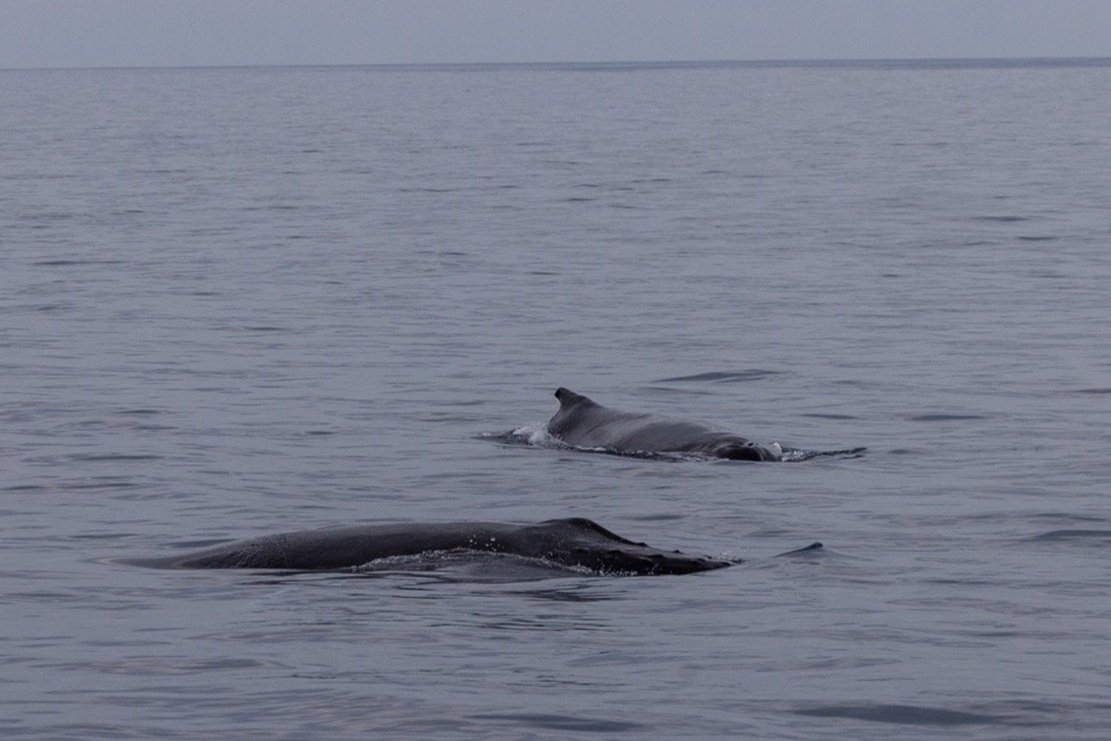

The interaction on board lasted for about half an hour with 3 dwarf minkes circling the boat. One in particular was very keen on the vessel, surfacing as close as 2-3 metres away on multiple occasions.
Dwarf Minke Whales in Western Australia
Most of what's known about dwarf minke whales comes from the northern Great Barrier Reef, where the whales gather predictably each June and July, the only place in the world where they're known to reliably approach humans in the water. Far less is known about the population that moves along Western Australia's coast, which is what made our sighting so valuable.
The details from our August encounter were passed on to Emily Evans, who is completing her PhD on dwarf minke whales in WA and works alongside colleagues from the Minke Whale Project in Queensland. Every confirmed sighting like this one helps researchers build a clearer picture of the species' behaviour and migration patterns on the west coast, an area that, unlike the Great Barrier Reef, doesn't yet have an established, predictable aggregation site.
Encounters like this are rare, which is part of what makes whale watching in WA so special, you genuinely don't know what you might see on any given trip.